Chronicle of Small Ends
Key art
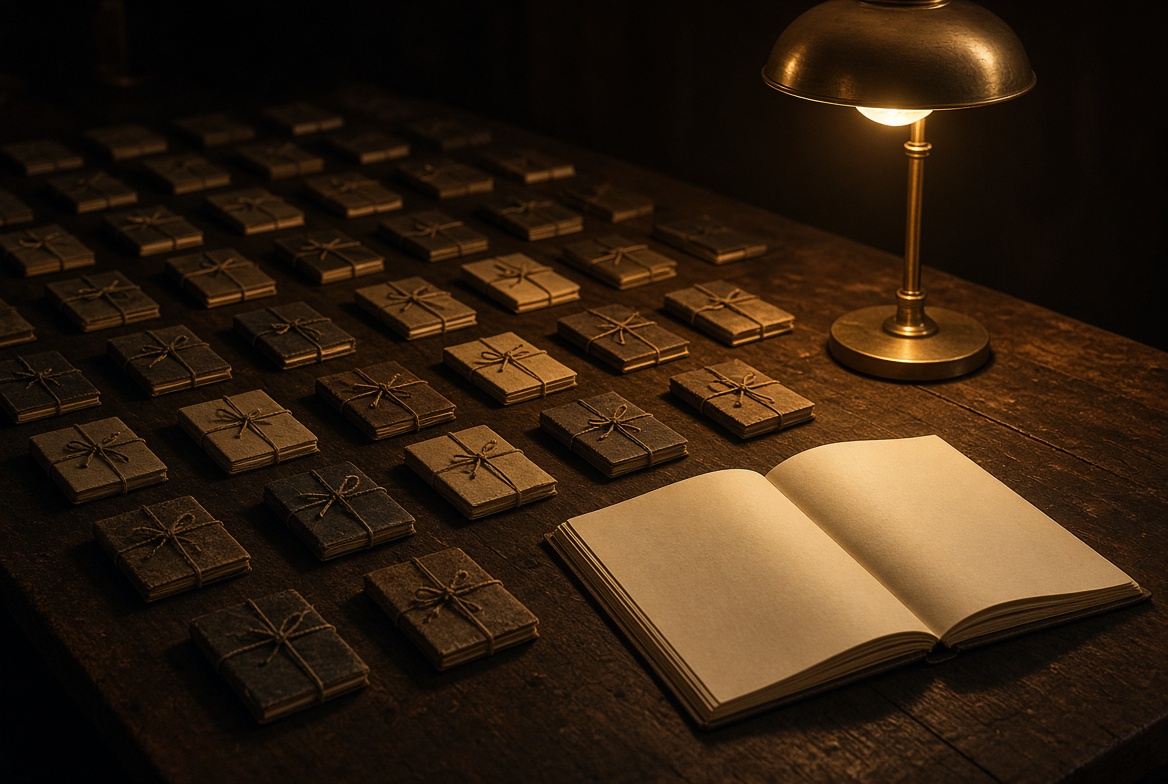
The screening
The picture is filed as Chronicle of Small Ends.
Scenario
2:57 · 16:9
Niles Arden writes endings too small for a monument. The logbook takes them one to a line, the paper thick, the ruling pale. A bakery key returned to a hook. A ferry whistle that did not sound at dusk. A stair lamp that was not replaced, noted without grief's enlarging voice. The ink of those lines is dry. He is the hand still filling the book, and the book is still the work. Quiet hours have their lines too, because they passed. A window beside the desk shows an ordinary street doing nothing that would ask for a heading. He does not look at it for long.
At the top of the page a space was ruled for a large heading, the kind that wants stone: a name, a date, a public loss. The space is blank and carefully measured, taller than the lines beneath. A draftsman's slip beside the book even proposes an inscription, letters drawn as if for carving, a date with room around it. Niles reads it. The proposed words are larger than anything the day has given him. He folds the slip once, the crease exact, and slides it under the blotter. The corner disappears. Stone is refused by the simple act of not copying it. He presses the blotter flat so the slip cannot be seen from the chair.
He returns to the small lines and adds a third: the last chair removed from a waiting room, time noted, no crowd described. The sentence fits on one line and stops. He does not add who sat there. He does not add why the chair was the last. The pen pauses. The street outside gives a cart sound and loses it. Together the lines are the only chronicle the day offered him. He does not gather them into a speech. He blots the third line. The blotter takes a little ink and gives the line a drier look. He numbers it, a small figure in the margin, and leaves the heading blank above them.
The pen cap stays off until the line is dull. Niles aligns the book with the desk edge, a small correction, and does not open a second volume that sits closed at his left. That volume's ribbon marker hangs at a place he does not consult. The window's ordinary street keeps its ordinary quiet. A bicycle bell sounds once far off and is not entered, because it is not an ending, only a passing.
Time passes as the fresh ink loses its shine. The first two lines stay as they were. The numbered figure feathers a hair into the paper fiber, a soft edge the other numbers do not have, and then it stops feathering. He does not rewrite the number. The folded slip under the blotter shifts enough to show a white corner and he pushes that corner back under without reading it again. Three short endings share the page. The large heading above them stays unwritten, and the feathered number dries beside a chair that the book will not describe further.
Shooting script
Scene 1. Ledger desk. Day. 2:57. 16:9.
One place. One hour. It stays one scene.
Niles Arden, 54, fills a thick log with endings small enough for one line, folds a too-large inscription under the blotter, and leaves the heading blank.
No dialogue.
Breakdown
Day hour for a thick log, a blotter, and a blank heading.
Cast. Niles Arden, 54. Plain office shirt. Alone at the desk.
Logbook. Thick paper, pale ruling. Already dry: a shop bit brought to a peg, a boat horn that stayed silent at dusk, a stair lamp left unreplaced. He adds a third line, the last chair taken from an ante space, hour logged, no sitters described. He blots it, numbers it in the edge, and leaves the large heading blank.
Slip and blotter. A draftsman's slip with glyphs inked as if for stonework, a day-mark with space around it. He reads it, folds it once on an exact crease, and tucks it under the pad. A white corner later shows, and he pushes it back without reading it again.
Pen. Cap stays off until the fresh line is dull. The counted digit bleeds a thread into the fiber, unlike the older numbers, then stops. He never rewrites it.
Second volume. Closed at his left. A cloth marker dangles at a spot he never consults. He aligns the open book with the desk edge and opens nothing else.
Window. An ordinary street with nothing that asks for a heading. A cart sound comes and goes. A bicycle bell far off sounds once and is left out of the page.
Shot list
Camera. One scene. 16:9.
Nobody looks into the lens. The sizes below are the decoupage, not the literary script.
1 · 0:00–0:13 · Wide. Niles sits at a desk beside a window on an ordinary street, a thick log open under his hand.
2 · 0:13–0:26 · Close. Dry lines already fill the page, each ending small enough to stop at the ruling.
3 · 0:26–0:39 · Medium. Above them a tall blank is ruled for a heading that wants a public size.
4 · 0:39–0:52 · Macro. A slip beside the book shows letters drawn at carving scale, a date with empty room around it.
5 · 0:52–1:04 · Close. He reads the slip, folds it once on an exact crease, and tucks it under the pad.
6 · 1:04–1:16 · Medium. He flattens the pad smooth so the note is hidden from the chair.
7 · 1:16–1:28 · Close. The pen adds a third short line, a last chair taken from a waiting room, and the sentence stops on that line.
8 · 1:28–1:41 · Macro. He blots the line, and the paper takes a drier look.
9 · 1:41–1:54 · Close. A small figure goes in the margin, and the nib lid remains off until the ink is dull.
10 · 1:54–2:06 · Medium. He aligns the open book with the desk edge and leaves the second volume closed, its ribbon unconsulted.
11 · 2:06–2:18 · Wide. The street stays ordinary, a cart sound rising and losing itself, a far bell left off the page.
12 · 2:18–2:31 · Macro. Fresh ink loses its shine, and the new number feathers a hair into the fiber, then stops.
13 · 2:31–2:44 · Close. A white corner of the slip shows, and he pushes it back under without reading.
14 · 2:44–2:57 · Medium. Three short lines share the page under a heading that stays unwritten.
Lookbook
Ordinary day on thick paper.
Day from the window is ordinary and flat, enough to read by, with no lamp required. It sits on the thick page, the pale ruling, and the wet ink until that ink goes dull. The folded slip disappears under the blotter and comes back only as a white corner, then is hidden again.
Palette
Thick paper. #F3EBD8. The log page and its pale ruling
Dry ink. #2C3138. The two lines already dull
Fresh ink. #1E3A5A. The third line before it dulls
Blotter. #C4B49A. The pad that hides the slip and takes a little ink
Slip white. #FFFaf2. The folded inscription and its returning corner
Desk wood. #7A5C40. The edge he aligns to the book
Ribbon. #7A3030. Marker in the closed volume
Street day. #D5D8DC. The ordinary window beyond the desk
Lens
Wide holds the desk and the ordinary window. Close and macro hold the pen, the margin number, the crease, and the white corner. The street stays outside this one room.
Costume
An office shirt for small lines.
Niles Arden is 54, in a plain muted office shirt, sleeves clear of ornament. No jacket is added for the heading he refuses.
The shirt stays the same from the first dry line to the last push of the corner. Ink stays on the blotter and the page. The cuff stays clean. The ribbon hangs on the closed book, not on him.
Design
A desk, a thick log, a hidden slip.
A ledger desk by a window on a quiet street. The open book is thick, pale-ruled, with a tall blank at the top. A closed second volume sits at his left with a ribbon he never pulls.
The slip must fold once, slide fully under a blotter, and later offer a white corner he can push back. The pen writes one short line, takes a blot, and leaves a margin number that feathers slightly into the fiber. The heading stays empty. A far bicycle bell is heard and left unwritten.
Makeup and hair
Ink on the page, not the cuff.
Niles is 54. Day on the face is plain, hair ordinary, eyes on the ruling and once on the slip. No grief paint is added.
The writing hand pauses, blots, and numbers. Fingers push a paper corner back. Skin takes no cut. The mouth stays closed, because the lines are never gathered into a speech.
Sound
No score. A pen, a blot, a far bell.
Pen. A short line, then quiet while the cap stays off until the ink dulls.
Blotter. One press that takes a little ink and dries the line.
Slip. A crisp fold, a slide under the pad, later a soft push of a corner.
Align. The book shifted once to the desk edge.
Cart. A street sound that comes and is lost. It is not entered.
Bell. One bicycle bell far off, left out of the log.
Ink. The feathering of the number is silent. The room tone stays the street's ordinary quiet.