Colony Lights
Key art
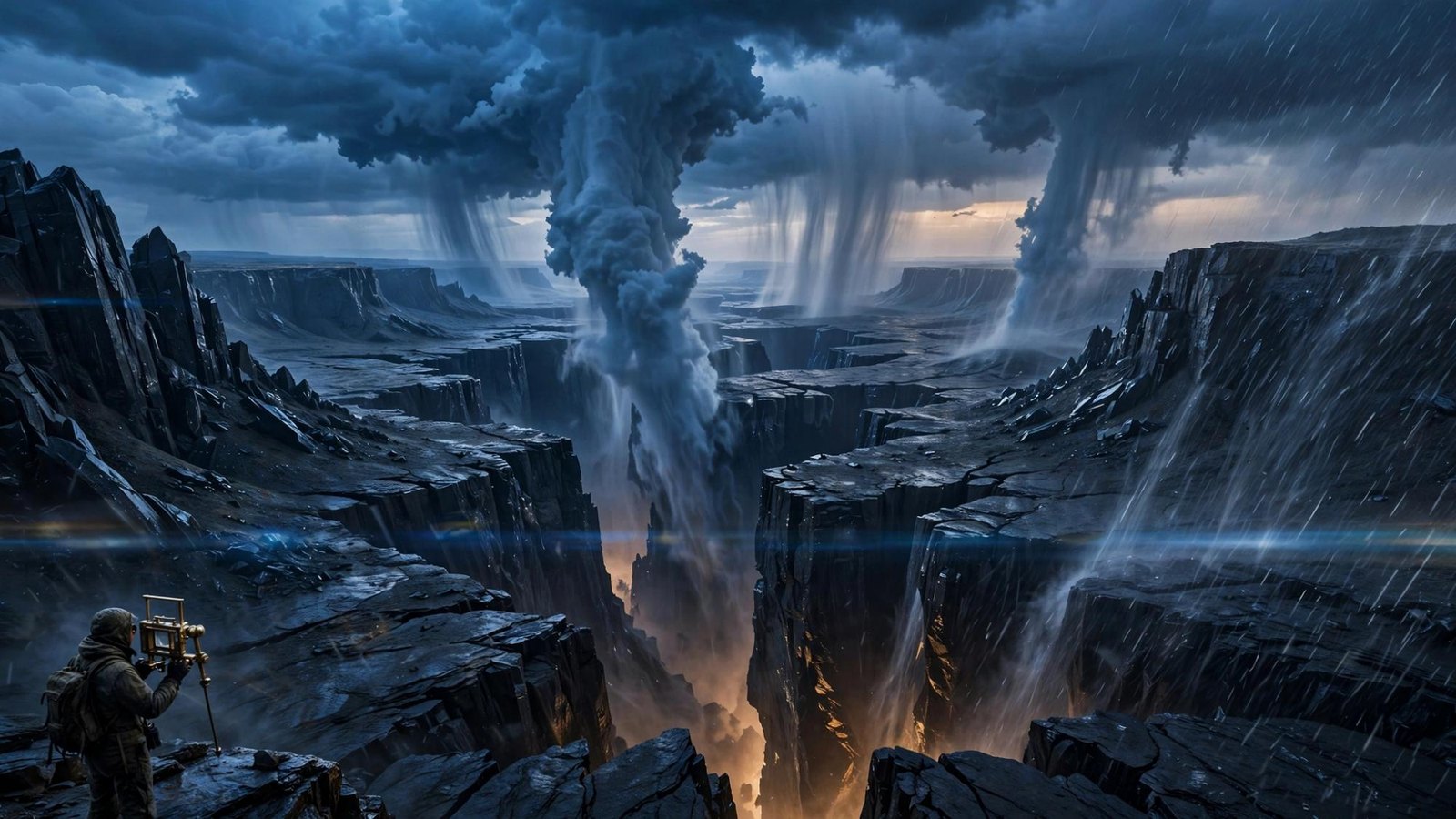
The screening
The picture is filed as Colony Lights.
Scenario
2:57 · 16:9
A figure stands alone on a basalt ridge. The canyon is open under the storm. There is no street in it. Wind pulls at the coat and at a strap on an instrument fixed to a tripod. The figure keeps a hand near the instrument and does not count out loud. Needles, if the instrument has them, are not read aloud. The canyon does not resolve into anything with a door. Cloud moves low and does not break into a shape a person could enter. Rain has not arrived. The air only tastes of it.
Lights kindle on the canyon floor, row after row, the pattern of a colony switching on. They come in order, near ridge first, then farther, a grid of small warm points where stone was. The figure does not count them. The points hold. In the cabin behind the ridge, a map lies under a lamp. The window of the cabin is the canyon, not a grid. While the figure watches the lights, the map draws streets by itself, fine and sure, matching the rows. Ink appears as a hairline, then a crossing, then a name-less block. The lamp does not flicker to explain it. The figure does not go to the table yet. The tripod creaks once in the wind and holds.
The canyon lights go out. They go in the order they came, far rows first, then the near, until the floor is stone again. The storm remains. The streets on the map do not go out. The figure comes to the table, looks from the new lines to the window, and stays at the edge of the table. A hand hovers over the freshest street and does not touch the wet ink. Outside, the tripod stands empty. The coat's absence is a smaller dark on the ridge. The canyon is only stone and weather.
He does not count the dried streets either. The tripod outside ticks when the wind changes and then stands mute. A drop hits the cabin roof, one, and does not become rain on the map. The figure's coat hem drips once onto the boards by the table and the drop stays round, separate from the ink.
Time passes as the lamp hums and the ink dries from the center of each new line toward its end. The newest street on the map continues a short distance after the last canyon light has died, a line drawing itself into blank paper, and then it stops mid-stroke, unfinished, with a small bulb of ink at the tip. The figure does not blot it. The map keeps its streets under the lamp. The window keeps the empty canyon. No light returns to the floor of it, and the drawn city stays on the paper alone, the unfinished stroke drying where the rows ran out.
Shooting script
Scene 1. Basalt ridge. Day. 2:57. 16:9.
One place. One hour. It stays one scene.
A man of 42 stands on a basalt ridge with an instrument on a tripod while warm points kindle and die on the canyon floor, and a map inside the cabin draws streets the lights leave behind.
No dialogue.
Breakdown
Day hour for a tripod, canyon points, and wet ink.
Cast. One man, 42. Coat and a hem that can drip once. Alone. He never counts aloud.
Ridge and canyon. Basalt ridge, open canyon, low cloud that never breaks into a door. Wind on the coat and on a strap. Rain has not arrived. One drop hits the cabin roof and never becomes rain on the map.
Instrument. Fixed to a tripod. His hand stays near it. The tripod creaks once and holds, then clicks when the air shifts and stands mute. After he leaves the ridge it stands empty.
Canyon lights. Rows of small warm points, close crest first, then beyond, a mesh where stone was. They die distant lines first, then the close, until the ground is rock again. No light returns.
Cabin map. A map under a lamp. The window is the gorge, not a mesh. Ink draws hairlines, crossings, and nameless blocks by itself. The newest street continues after the last canyon light and stops mid-stroke with a bulb of ink. He never blots it. His hem drips one round drop on the boards, separate from the ink.
Shot list
Camera. One scene. 16:9.
Nobody looks into the lens. The sizes below are the decoupage, not the literary script.
1 · 0:00–0:13 · Wide. A coated figure waits solo on a dark-rock crest above an open canyon, one hand near an instrument on a tripod.
2 · 0:13–0:26 · Medium. Wind pulls the coat and the strap, cloud stays low, and the air only tastes of rain.
3 · 0:26–0:39 · Wide. Warm points kindle on the canyon floor in sequence, close crest first, then beyond, a mesh where stone was.
4 · 0:39–0:52 · Medium. Inside the cabin a map under a lamp begins to draw streets by itself, hairline, crossing, and block.
5 · 0:52–1:04 · Close. He stays on the ridge, and the stand groans once in the air and stays.
6 · 1:04–1:16 · Wide. The canyon lights die in the sequence they arrived, distant lines first, until the ground is rock again.
7 · 1:16–1:28 · Medium. The streets on the map stay, and he comes to the table, looking from the fresh strokes to the glass.
8 · 1:28–1:41 · Close. A palm pauses over the newest ink and never touches it.
9 · 1:41–1:54 · Wide. Outside, the empty tripod is a smaller dark where the coat had been, and the gorge is only rock and sky.
10 · 1:54–2:06 · Close. The tripod ticks when the wind changes, then stands mute.
11 · 2:06–2:18 · Macro. One drop hits the cabin roof and never reaches the map.
12 · 2:18–2:31 · Close. The jacket edge drops once onto the planks, and the drop stays round, apart from the ink.
13 · 2:31–2:44 · Macro. Pigment sets from the middle of each new stroke out to its end, and the newest stroke continues a short way, then stops with a bulb at the tip.
14 · 2:44–2:57 · Wide. The sheet holds its roads under the bulb, and the glass holds the vacant gorge.
Lookbook
Warm points on canyon stone.
Day on the ridge is storm-colored, cloud low, no break into a shape with a door. The canyon's own light is a mesh of small amber dots that kindle in order and die in order. Inside, a lamp holds the map while ink draws under it, and that lamp never flickers to explain the lines.
Palette
Basalt. #3A4048. Ridge and canyon stone
Storm cloud. #6E7680. Low cloud that stays unbroken
Warm point. #E7A04A. Colony lights on the canyon floor
Coat. #2E3430. The figure on the ridge, then the hem indoors
Tripod. #5C656C. The instrument stand left in the wind
Map paper. #EFE6D4. The sheet that grows streets
Wet ink. #1A2740. Hairlines, crossings, and the end bulb
Cabin lamp. #F0D7A4. The lamp over the map
Lens
Wide holds the ridge, the canyon, and the cabin window as one place. Close holds the hovering hand, the ink bulb, and the single drop from the hem. The drawn streets stay on paper inside this same hour.
Costume
A coat the wind keeps pulling.
The man is 42, in a field coat the wind can pull, with room for one hand near the instrument. No gloves are required.
The change is the hem: after he comes inside, it drips once onto the boards, a round drop kept apart from the ink. On the ridge the coat's absence is only the smaller dark he left. The strap belongs to the instrument, not to a second garment.
Design
Ridge, tripod, a map that draws.
Basalt ridge over an open canyon, a cabin just behind with a window on that canyon, a lamp, and a map on a table. An instrument on a tripod must creak, tick, and stand empty.
Canyon lights are practical points in rows, on from near to far, off from far to near. The map draws matching streets in wet ink and must stop mid-stroke with a bulb after the lights are gone. One roof drop falls. One hem drop stays round on the boards. He never blots the unfinished line.
Makeup and hair
Wind on the face, ink untouched.
He is 42. Wind on the face and hair, skin adult and unmarked. The mouth stays closed, because he never counts aloud.
The hand hovers over wet ink and stays clean of it. Indoors the face is lamp-lit, still turned between map and window. No soot, no rain-streaked wound. One drip belongs to the hem, not to the brow.
Sound
No score. Wind, a tripod creak, one roof drop.
Wind. On the coat and the strap, then a change that makes the empty tripod tick and go mute.
Tripod. One creak while he is still on the ridge. Later a tick with nobody at the instrument.
Lights. The points themselves are silent, on and then off in order.
Lamp. A steady hum inside, no flicker.
Ink. Silent drawing. No blot. The bulb at the tip adds nothing audible.
Roof. A single drop on the cabin roof, never a rain.
Hem. One drip onto the boards, round and separate.