Erasure Protocol
Key art
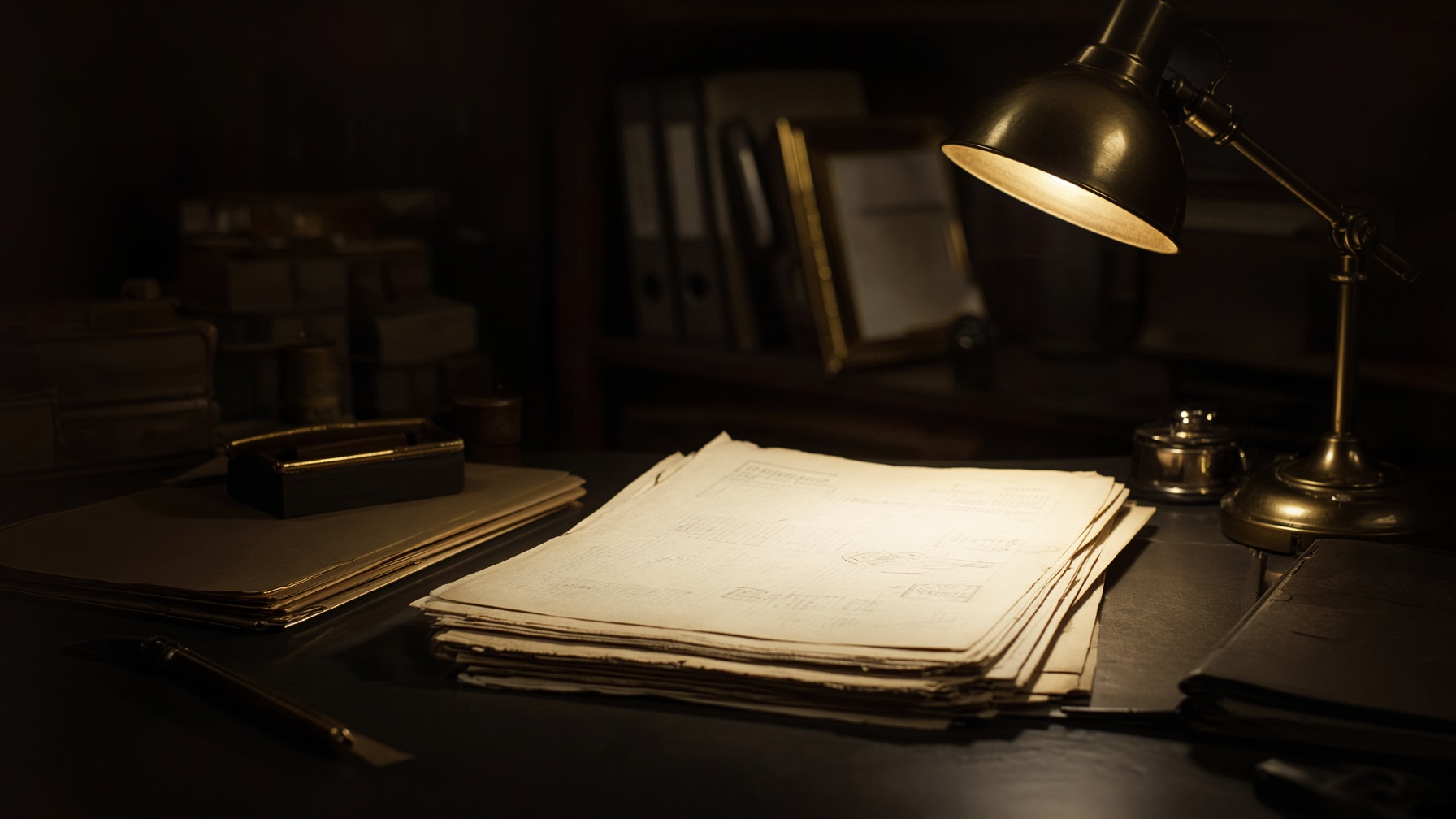
The screening
The picture is filed as Erasure Protocol.
Scenario
2:57 · 16:9
Vesper Lang works at a scarred desk with a lamp, a tray of forms, and a block of black ink. No screen shares the work. The scar in the wood is old and ink-stained at its edges. She takes a form that still has a stranger's name in a narrow box and lays the ink down in even strokes until every letter is covered. The strokes are patient. The boxes read complete. The protocol, on paper, is finished. She holds the form to the lamp and no letter shows through the black. She slides that form into a manila sleeve and sets the sleeve square to the desk.
She draws out a second sheet, the one that carries her own line. The ink there has already been lifted once. A pale trough remains where the pen pressed, an outline with no letters willing to stay filled. She can see it when the lamp rakes the paper and lose it when the lamp is flat. She wets a cloth and works the trough again. The paper roughens. Fibers lift. The outline does not leave. It sits in the fiber, empty to a glance and not empty to a finger. She runs a fingertip along it and feels the groove, letter-length, letter-gap, and still no letter she will say.
The lamp heat reaches the wet sheet and the damp gives up a faint smell of paper, nothing sweeter. Vesper turns the sheet a quarter turn and the trough catches the light along its whole length, a pale road with no name living in it. She turns it back. The stranger's sleeve, already dry, curls at one corner as the room's air finds it, and she presses the corner flat with a clean finger. The black inside does not crack. No letter climbs out of that black to replace the one she covered. The corridor beyond the bell stays empty of anyone bringing a fresh form.
A clerk's bell rings somewhere down the corridor and fades. Vesper does not call a name back into the trough to soften it. She does not invent a fresh line to stand where the old one lived. She blots the damp, sets the sheet under the lamp, and waits while the water leaves. The waiting is the rest of the work. The completed stranger's form is a flat black quiet in its sleeve. Her own sheet looks blank until the lamp rakes it. Then the outline returns, paler than the paper around it and darker than a true blank.
Time passes as the water retreats from the edges of the sheet toward the trough and disappears there. A single fiber along the trough lifts and lies back down in a curve that is almost a letter and is not one, and the curve stays. The outline of her name dries in the fiber. Her cloth stays folded beside it, damp at one corner, and the black sleeve of the stranger's form does not open again.
Shooting script
Scene 1. Paper bureau. Day. 2:57. 16:9.
One place. One hour. It stays one scene.
Vesper Lang covers a stranger's name in black and works a pale trough on her own sheet until the fiber still holds the groove.
No dialogue.
Breakdown
Day hour. Black ink, a sleeve, and a trough.
Cast. Vesper Lang. One adult woman at a scarred desk. No one brings a fresh form.
Desk. Scarred wood, ink-stained at the old edges. A lamp. A tray of forms. A block of black ink. No screen.
Stranger form. A form with a name in a narrow box. Even black strokes until no letter shows through at the lamp. A manila sleeve, squared, one corner that curls and is pressed flat.
Own sheet. A sheet whose line was lifted once. A pale trough in the fiber, letter-length and letter-gap, empty to a glance. It roughens under a wet cloth and dries with the outline still there.
Cloth. A cloth that wets the trough and ends folded, damp at one corner.
Corridor bell. A clerk's bell somewhere down the corridor. It rings and fades. The corridor stays empty of a new form.
Shot list
Camera. One scene. 16:9.
Nobody looks into the lens. The sizes below are the decoupage, not the literary script.
1 · 0:00–0:12 · Wide. A scarred desk holds a lamp, a tray of sheets, and a block of dense ink.
2 · 0:12–0:23 · Medium. Vesper Lang lays a form with a stranger's name under the lamp.
3 · 0:23–0:35 · Close. Even black strokes cover every letter in the narrow box.
4 · 0:35–0:46 · Macro. She raises the form to the worklight and the black stays opaque.
5 · 0:46–0:58 · Medium. She puts the blackened sheet in a tan wrapper and squares that wrapper on the desk.
6 · 0:58–1:10 · Close. A second sheet shows a pale trough where a line was lifted and no letters remain.
7 · 1:10–1:22 · Medium. She wets a rag and works the trough again.
8 · 1:22–1:33 · Macro. Fibers lift, the paper roughens, and a fingertip still feels the empty groove.
9 · 1:33–1:45 · Close. She rotates the sheet a fourth turn, and the groove catches the lamp along its length.
10 · 1:45–1:57 · Medium. She turns it back, and a dry corner of the sleeve curls.
11 · 1:57–2:09 · Close. A clean finger presses that corner flat, and the black inside stays unbroken.
12 · 2:09–2:21 · Wide. A clerk's bell rings down the corridor and fades.
13 · 2:21–2:33 · Medium. She blots the damp and sets her sheet under the lamp.
14 · 2:33–2:45 · Close. Water retreats from the edges toward the groove and disappears there.
15 · 2:45–2:57 · Macro. One fiber along the trough lifts into a bend that is almost a letter, then lies back, still short of a letter.
Lookbook
Desk lamp raking pale fiber.
A desk lamp is the source, close and warm on scarred wood. Held to the lamp, the stranger's black stays opaque. Raked across her sheet, the same lamp finds a pale trough the flat light loses. Heat from the lamp pulls the damp back toward that groove.
Palette
Lamp warm. #F0D8B0. The pool on the desk
Scarred wood. #6B4A32. Desk, ink at the old edges
Black cover. #161411. Strokes over the stranger's box
Manila. #D8B98A. The sleeve
Pale trough. #E7DCC8. The groove, lighter than the sheet
Sheet. #F4EBD8. Her paper around the trough
Wet fiber. #CDB892. Roughened damp along the groove
Corridor. #9AA0A4. Day beyond the desk, empty
Lens
Wide holds the scarred desk and the start of the corridor. Medium holds Vesper at the lamp. Close and macro hold the black strokes, the trough under a fingertip, and the single curved fiber. No screen shares the desk.
Costume
Unnamed cloth, ink kept on paper.
Vesper Lang is 43. The page names no garment.
Black ink stays on the stranger's form and in the sleeve. Her cloth takes none of it. The damp cloth is a tool, folded at the end with one wet corner, and it is not what she wears.
No clerk comes down the corridor to be dressed.
Design
A desk for covering and for a groove.
A paper bureau desk, scarred and ink-stained at the edges, with one lamp, trays of sheets, and a block of dense ink. No screen. A corridor beyond can carry a bell and stay empty.
One form must accept even black until the lamp shows no letter through it, then live in a manila sleeve that can curl at a corner and be pressed flat. The second sheet carries a pale trough that a fingertip can read and a glance can miss. A wet cloth roughens the fiber without lifting the outline.
The lamp has to rake and to heat. Water on the sheet retreats toward the trough. One fiber can lift into a curve and lie back, still not a letter.
Makeup and hair
A fingertip in the groove.
Vesper's face stays over the lamp, turning the sheet and turning it back. No paint.
The hands lay black in even strokes, hold paper to the light, wet the cloth, and follow the groove with a fingertip. A clean finger presses the sleeve corner.
Hair stays out of the lamp heat. The page gives it no event. Skin takes the paper smell and no stain.
Sound
No score. Ink, paper fiber, a corridor bell.
Ink strokes. Patient, even passes over the narrow box. Then quiet.
Sleeve. A slide of manila and a square set-down. Later a soft curl and a finger press.
Wet cloth. A damp working of the trough. Fibers lift with a faint rough sound.
Lamp heat. No tick. Only the faint smell of paper as the damp gives up. The sound is the retreat of water, nearly silent.
Bell. A clerk's bell down the corridor, then a fade. No name is called back.
Blot. A soft press on the damp sheet.
Fiber. One tiny lift and lie-back along the trough. Almost nothing.