Widow's Geometry
Key art
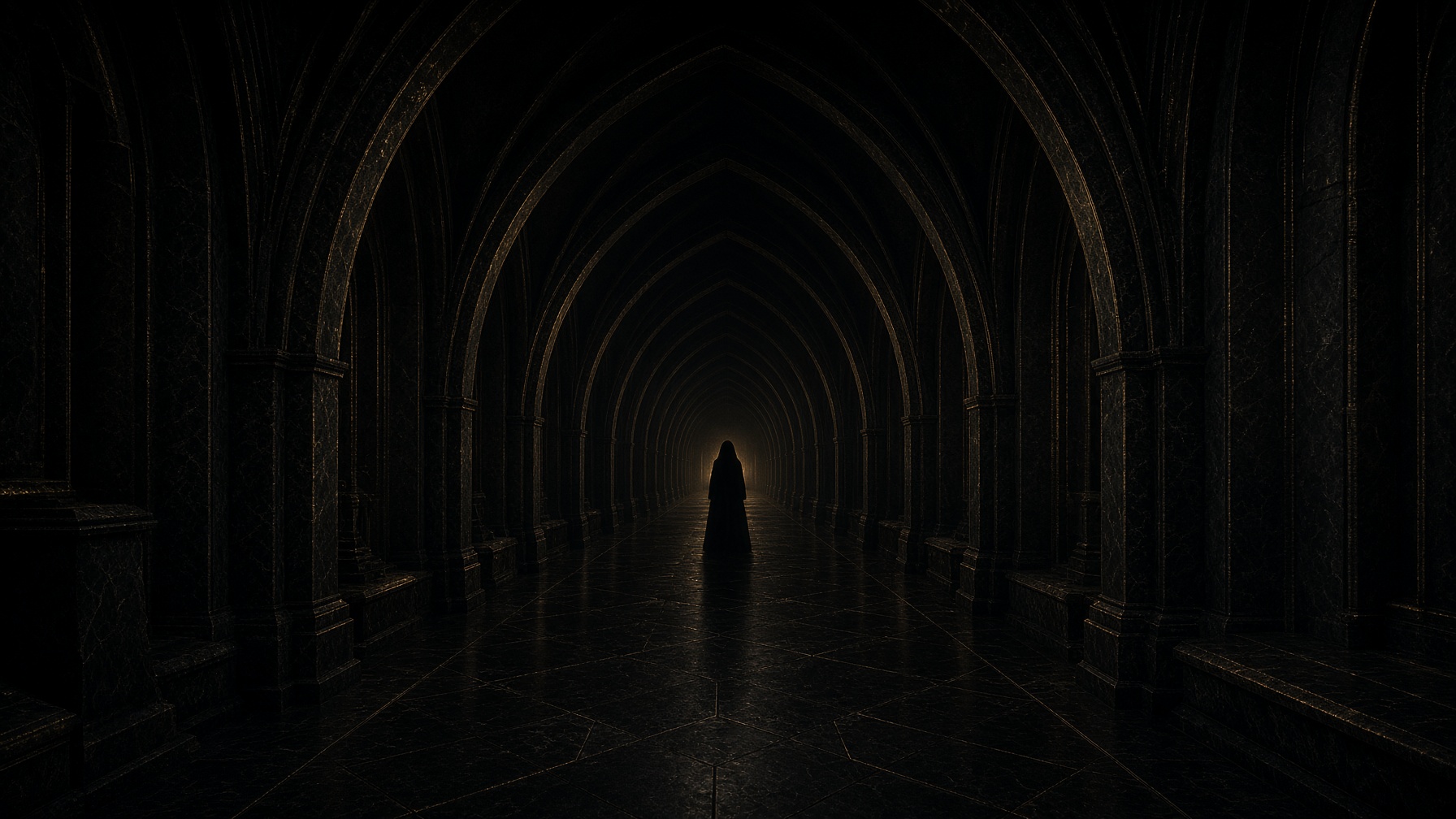
The screening
The picture is filed as Widow's Geometry.
Scenario
2:57 · 16:9
A widow in black sits beside an empty chair at a long table. The chair is drawn out, keeping a place the room still counts. Portraits hang in a cold row. Their paint does not brighten when the grey at the window shifts. The window is shut. Weather presses the glass and does not come in. On the table a sheet shows a spider and a web drawn as a diagram of this room: chair, window, door, and her seat. The ink is dry. A corner of the sheet lifts in a draft and settles back on the same lines. She waits with her hands in her lap until the corner has lain still.
A man in a red coat stands in the doorway and does not enter. His coat does not brush the jamb. The angles between him, the widow, and the empty chair match the drawing. He stays on the threshold long enough for the match to be plain, one boot on the sill and one still in the hall. She does not turn the sheet to hide it. Her hand finds the scissors. The blades are cold. She parts the diagram by hand, opening the line that joins her place to the empty chair. The paper separates with a soft tear along that one join and no other. The two halves lie a finger apart. The empty chair slides, untouched, to the edge of the table. Its legs whisper on the boards and stop where the light from the window is thinner. The man in red crosses and sits. The seat faces her now. It is no longer beside her. The red coat settles. He puts his hands on the table edge and does not reach across the gap.
She sets the scissors down. They rest across a margin the diagram no longer uses. A living spider crosses the parted sheet. It tests the gap with one thread, draws back, and strings a web over the opening she made, repeating the diagram in thread. The new strand tightens. The parted edges of the paper lift a little toward each other and do not meet. A second strand follows the first, lower, and stops short of her sleeve. Under that second strand the ink line she opened pales, as if the thread had taken the work of joining away from the paper. The portraits keep the walls. None of them changes its painted dark. The chair at the table's edge holds the man in red. The widow remains beside the place she opened.
The web does not grow a third strand. The spider stays at the center of what it has made and does not cross onto her half. Grey light stays on the shut window. A drop on the outside glass slides and stops. The scissors do not move. The chair does not slide back to her side. Thread holds the gap the paper will not close, and the widow's hands remain on her own half of the sheet while the man in red keeps the seat that now faces her across a join made of thread instead of ink.
Shooting script
Scene 1. Portrait room. Day. 2:57. 16:9.
One place. One hour. It stays one scene.
A widow in black and a red-coated man share a portrait room while a diagram sheet parts and a spider threads the gap.
No dialogue.
Breakdown
Day hour. The portrait room, the diagram, and the empty chair.
Cast. Widow, fifty-two, black dress, seated. Man, forty-one, red coat, first in the doorway and then in the chair. No third person.
Table and chairs. A long table. One chair for the widow. One empty chair drawn out, able to slide untouched to the table's far edge. Boards that whisper under the legs.
Portraits. A cold row of painted portraits. Paint stays dark when the window grey shifts. None of them changes face.
Window. One shut window. Grey weather pressed to the outside glass. One drop that slides and stops. No weather inside.
Diagram and scissors. One dry-ink sheet: a spider, a web, and this room as chair, window, door, and her seat. Scissors cold in the hand, able to open one join only. Two halves that can lie a finger apart.
Spider. One living spider. Thread enough for two strands across the torn join, the second strand stopping short of her sleeve. The ink line under that strand able to pale.
Shot list
Camera. One scene. 16:9.
Nobody looks into the lens. The sizes below are the decoupage, not the literary script.
1 · 0:00–0:16 · Wide. A widow in black sits beside an empty chair at a long table under a row of dark portraits.
2 · 0:16–0:28 · Medium. Grey weather presses the shut window while a corner of the diagram lifts and settles.
3 · 0:28–0:38 · Close. The sheet shows a spider, a web, and the room as chair, window, door, and her seat.
4 · 0:38–0:49 · Wide. A red-coated man stands in the doorway, one boot on the sill and one still in the hall.
5 · 0:49–1:01 · Medium. Her hand finds the scissors and the blades read cold against the paper.
6 · 1:01–1:11 · Close. She parts one join only, and the sheet separates with a soft tear.
7 · 1:11–1:23 · Macro. A finger of bare table shows between the parted halves.
8 · 1:23–1:34 · Wide. The empty chair slides, untouched, to where the window light is thinner.
9 · 1:34–1:44 · Medium. The man crosses, sits facing her, and sets his hands on the table edge.
10 · 1:44–1:56 · Close. She sets the scissors down across a margin the diagram no longer uses.
11 · 1:56–2:07 · Macro. A living spider tests the gap, draws back, and strings a thread over the opening.
12 · 2:07–2:19 · Close. A second strand follows lower and stops short of her sleeve as the opened ink pales.
13 · 2:19–2:29 · Medium. The parted paper edges lift a little toward each other and stay apart.
14 · 2:29–2:43 · Wide. Portraits keep their dark along the walls while the man holds the facing seat.
15 · 2:43–2:57 · Medium. Her hands stay on her half of the sheet, thread holding the join the ink has left.
Lookbook
Grey day on shut glass.
Grey day sits outside a shut window and comes in only as a cooler wash. It thins along the table's far edge, which is where the empty chair travels. The diagram's dry ink stays dark until the second thread crosses the tear, and then that one opened line pales under the strand. The red coat takes the warmer note in the room. The portraits refuse the window's shift and keep their painted dark.
Palette
Widow black. #1C1B1E. Her dress against the pale sheet
Red coat. #8B2C30. The man's coat in the doorway and the chair
Window grey. #A3ABB0. Shut glass and the weather on it
Diagram paper. #E4D9C8. The sheet on the long table
Dry ink. #2C2826. The drawn web, paler after the thread
Spider thread. #C9C3B4. Two strands over the torn join
Table wood. #6A5040. Boards and the long table
Portrait brown. #3F3330. Painted dark along the wall
Lens
Wide holds the long table, the portrait row, the shut window, and both chairs. Medium holds the widow and the red coat from doorway to seat. Close and macro hold the scissors, the torn join, the spider, and the two strands.
Costume
Black for the widow, red for the man who sits.
The widow is fifty-two. She wears black, matte, long-sleeved, with her hands free for the scissors and then for her half of the sheet. The dress stays black and stays in the chair beside the place she opens. No jewel is added.
The man is forty-one. The red coat is the only strong color he carries, cut so it clears the door jamb on the way in. It settles when he sits. His hands come to the table edge and stay on his own side of the gap. The coat is the change the room accepts: a red shape moving from threshold to facing chair.
Design
A long table, a shut window, and a row of portraits.
The room needs a long table, two chairs, a shut window, and a cold row of portraits whose paint stays dark. Weather stays on the outside of the glass, with one drop that can slide and stop. The empty chair must slide, untouched, toward the thinner light at the table's edge.
The diagram is one dry sheet inked with a spider and a web that maps chair, window, door, and her seat. It must tear along a single join. Scissors rest afterward on an unused margin. A living spider must cross the gap with two strands only, and the opened ink line must be able to pale under the second strand.
Makeup and hair
Cool skin, and hands that part paper.
The widow is fifty-two. Hair is dressed close, no loose strand over the sheet. Skin is pale and cool in the grey window light. Her hands do the work: lap, then scissors, then her own half of the paper. Nails are short and unpainted.
The man is forty-one. Hair is combed, face clean, no mark added for the doorway wait. His hands show only the table edge. The spider is a real spider on the sheet, separate from either body. No wound is painted on either person.
Sound
No score. A paper tear, chair legs, and a spider's thread.
Window weather. A muffled press of weather on shut glass. One drop slides and stops. Nothing wet enters.
Paper corner. A small lift and settle of the sheet in a draft, early, before any hand moves it.
Soft tear. One soft tear along a single join when the scissors part the diagram. No second rip.
Chair whisper. Legs whisper on the boards as the empty chair slides to the thin light, then stop.
Coat settle. Cloth settles once as the red coat takes the facing seat. Hands meet the table edge with a dull touch.
Spider thread. A faint tick of legs, then the tiny pull of two strands. The second strand stops short of cloth.
Held gap. After the thread, the room keeps only the window's muffled weather and the quiet of two still people.