Harvest of the Unseen
Key art
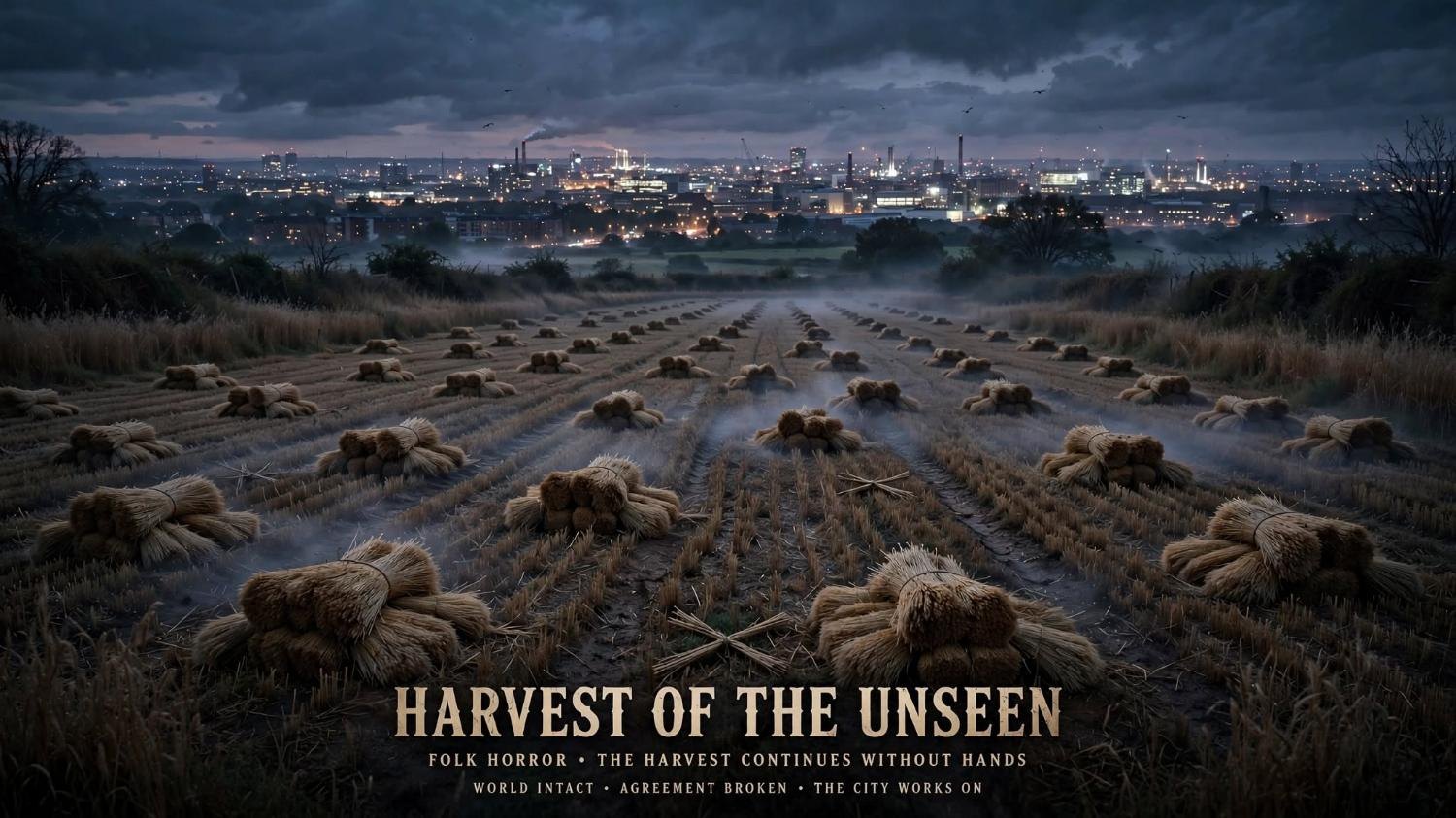
The screening
The picture is filed as Harvest of the Unseen.
Scenario
2:57 · 16:9
Bound sheaves stand in long rows across a darkening field. No one with a blade is anywhere among them. Stubble pricks the ground between the rows. The light fails by degrees and the sheaves keep their shape. Past the hill a city keeps its lights, windows busy, streets pricked with small lamps that do not go out. A woman crosses the stubble carrying a blackened steel clip that holds a single ear of wheat. The clip is marked as one of twelve. The mark is worn but readable. Hooded figures stand in a line at the field's edge, between her and that distant glow. Their hoods do not turn as she passes. The wheat ear ticks against the steel when her step jars it.
She steps into the dark of the barn. The air is cooler. Dust hangs at the height of her shoulders and does not settle while she stands in the doorway. The sheaves are no longer in rows. They stand in a closed circle on the packed floor, and nobody's hands are on them. She counts eleven. She counts them again, touching nothing, and the number stays eleven. She lifts the clipped ear into the doorway light. The grains take the last dusk and shine a dull gold. She holds it there. Outside, one hooded figure's hem stirs and goes still. When she lowers the ear, a twelfth sheaf has joined the circle, upright in dust that shows no new footprint. The dust around its base is smooth, smoother than the dust the other sheaves have disturbed by simply standing.
She backs to the barn door and stops there. The twelfth sheaf leans a finger inward, toward the empty middle, and then stands straight again. No hand corrects it. The hooded line outside has not shifted an inch. The city lights go on working beyond the hill, a window lighting, another already lit, none of them answering the barn. In the barn the circle of sheaves holds its place. The single ear stays fast in the steel. The clip's mark does not wear any further. She does not set the ear into the circle and does not take it back into the field.
Dusk finishes in the doorway and leaves the circle in its own dark. The smooth dust at the twelfth sheaf does not take a print. The hooded line keeps the edge of the field. The woman remains in the doorway with the clipped ear lowered, and the twelve sheaves stay closed around a middle no one enters.
She does not step back into the rows. The stubble outside the door stays empty of any other walker. One city lamp far past the hill goes out and another takes its place, a trade the field does not answer. Inside, the circle's dust settles a last fraction and then will not settle more. The steel clip warms where her fingers have held it and does not loosen. The ear of wheat stays single. Eleven sheaves and the twelfth keep the same height, and the doorway holds her there with the dark of the barn in front and the city's small lights behind.
Shooting script
Scene 1. Field and barn. Dusk. 2:57. 16:9.
One place. One hour. It stays one scene.
A woman carries a clipped ear of wheat into a barn where eleven sheaves become twelve, while hooded figures hold the field's edge.
No dialogue.
Breakdown
Dusk hour. The barn circle, the steel clip, and the twelfth sheaf.
Cast. Woman, forty-seven, crossing the stubble and stopping in the barn doorway. Hooded adults in a line at the field's edge. No one with a blade. No one inside the circle of sheaves.
Field. Bound sheaves in long rows. Stubble between them. A hill. A distant city whose windows and small lamps stay busy, one lamp going dark while another takes its place.
Clip and ear. A blackened steel clip marked as one of twelve, the mark worn and still readable. One ear of wheat held in it. Grains that can take a dull gold in the doorway light. The clip warms in the hand and stays fastened.
Barn circle. Packed floor. Dust at shoulder height in the doorway. Sheaves moved from rows into a closed circle. The count starts at eleven. A twelfth sheaf must appear upright in smooth dust, lean a finger inward, and stand straight again.
Hoods. A line of hooded figures between the woman and the city glow. Hoods stay unturned as she passes. One hem stirs and goes still. The line holds its inches.
Doorway. The barn door as her stopping place, dusk finishing there, field dark in front of her inside and city lamps behind.
Shot list
Camera. One scene. 16:9.
Nobody looks into the lens. The sizes below are the decoupage, not the literary script.
1 · 0:00–0:16 · Wide. Bound sheaves stand in long rows across a darkening field, stubble between them.
2 · 0:16–0:28 · Medium. Past the hill a city keeps its windows and small lamps lit.
3 · 0:28–0:38 · Wide. A woman crosses the stubble with a blackened steel clip holding one ear of wheat.
4 · 0:38–0:49 · Close. Hooded figures hold a line at the field's edge; their hoods stay unturned as she passes.
5 · 0:49–1:01 · Macro. Each jar of her step taps the ear against the steel; the worn mark still reads.
6 · 1:01–1:11 · Medium. She steps into the barn; dust hangs at the height of her shoulders.
7 · 1:11–1:23 · Wide. Inside, the sheaves stand in a closed circle on the packed floor; she counts eleven.
8 · 1:23–1:34 · Close. She raises the clipped ear into the last light of the door; the grains take a dull gold.
9 · 1:34–1:44 · Medium. One hooded hem outside stirs and goes still.
10 · 1:44–1:56 · Wide. When she lowers the ear, a twelfth sheaf stands in the circle in dust that shows no footprint.
11 · 1:56–2:07 · Macro. The dust at that base is smoother than the dust around the others.
12 · 2:07–2:19 · Medium. The twelfth sheaf leans a finger inward and stands straight again.
13 · 2:19–2:29 · Wide. She remains in the doorway; the city trades one lamp for another beyond the hill.
14 · 2:29–2:43 · Close. The clip is warm in her fingers and still fastened; the ear stays single.
15 · 2:43–2:57 · Wide. Dusk finishes in the door; twelve sheaves hold a middle nobody enters.
Lookbook
Dusk caught on black steel.
Dusk fails by degrees across the stubble and catches the wheat ear only when she lifts it into the doorway. The grains go a dull gold in that last light, then lose it when she lowers the clip. Inside the barn the circle falls into its own dark, while the city beyond the hill keeps small hard lamps. Dust at her shoulders takes the doorway as a pale band and stays hanging.
Palette
Stubble. #8A7048. Cut field between the sheaf rows
Sheaf gold. #C4A05A. Bound wheat in the last dusk
Barn dark. #2A241C. The packed interior after dusk finishes
Steel clip. #3E4246. Blackened clip around the single ear
Doorway dust. #C2B6A2. The pale band at her shoulders
Hood cloth. #1E2428. The line at the field's edge
City lamp. #E6D7A8. Small lights past the hill
Smooth dust. #8A8174. Unprinted floor at the twelfth sheaf
Lens
Wide holds the sheaf rows, the barn door, and the distant city. Medium holds the woman in the doorway and the hooded line. Close and macro hold the clip, the worn mark, the dull gold grains, and the smooth dust at the twelfth base.
Costume
A working coat against a line of hoods.
The woman is forty-seven. She wears a dark field coat, hem at the knee, practical and unadorned. The coat takes barn dusk and stays the coat she crossed the stubble in. No sash, no blade, no second layer removed.
The hooded adults wear black cloth, hoods forward, faces unshown. One hem stirs and goes still. That small lift is the only change in their clothes. They hold the line and keep the hoods unturned.
Design
Rows of sheaves, then a circle on a barn floor.
The ground is a darkening field of bound sheaves in rows, stubble between, a hill, and a city of small lamps beyond it. One of those lamps must be able to go out while another comes on. A line of hooded figures stands at the field's edge.
The barn is cooler, with dust that can hang at shoulder height. The sheaves in the barn are a closed circle, first eleven, then twelve. The twelfth must arrive upright in smooth, unprinted dust, lean inward a finger, and stand straight. The woman's prop is a blackened steel clip, marked as one of twelve, holding a single ear whose grains can catch dull gold in the doorway.
Makeup and hair
Field dusk on a face, dust at the shoulders.
The woman is forty-seven. Hair is tied back for the field, a few stalks of stray hay allowed, nothing arranged. Skin is weathered. Her fingers warm the steel and stay closed on the clip. No cut is added to the hands.
The hooded line keeps faces inside cloth. Only a hem moves, so no makeup reads on them. Dust at the barn door hangs in the air beside her cheek and settles a last fraction on the floor, not as powder on her skin.
Sound
No score. Stubble, a wheat tick, and a quiet barn.
Stubble. Dry prickle under her steps as she crosses between the rows. It fades when she reaches the barn door.
Wheat tick. The single ear taps the steel clip when a step jars it. The tap stops once she holds still in the doorway.
Barn air. Cooler quiet inside. Dust makes no sound while it hangs. The circle of sheaves is still.
Hem. One soft stir of hood-cloth outside, then stillness in the line.
Twelfth sheaf. The new sheaf arrives without a footstep. A faint lean of dry straw, then it stands. The dust takes no print.
City. A far, thin electrical presence beyond the hill. One lamp drops out of that bed and another replaces it. The field gives no answer.
Clip. Fingers stay on warm steel. No loosen of the catch. Dusk ends on a quiet doorway.