The Lost Inventory
Key art
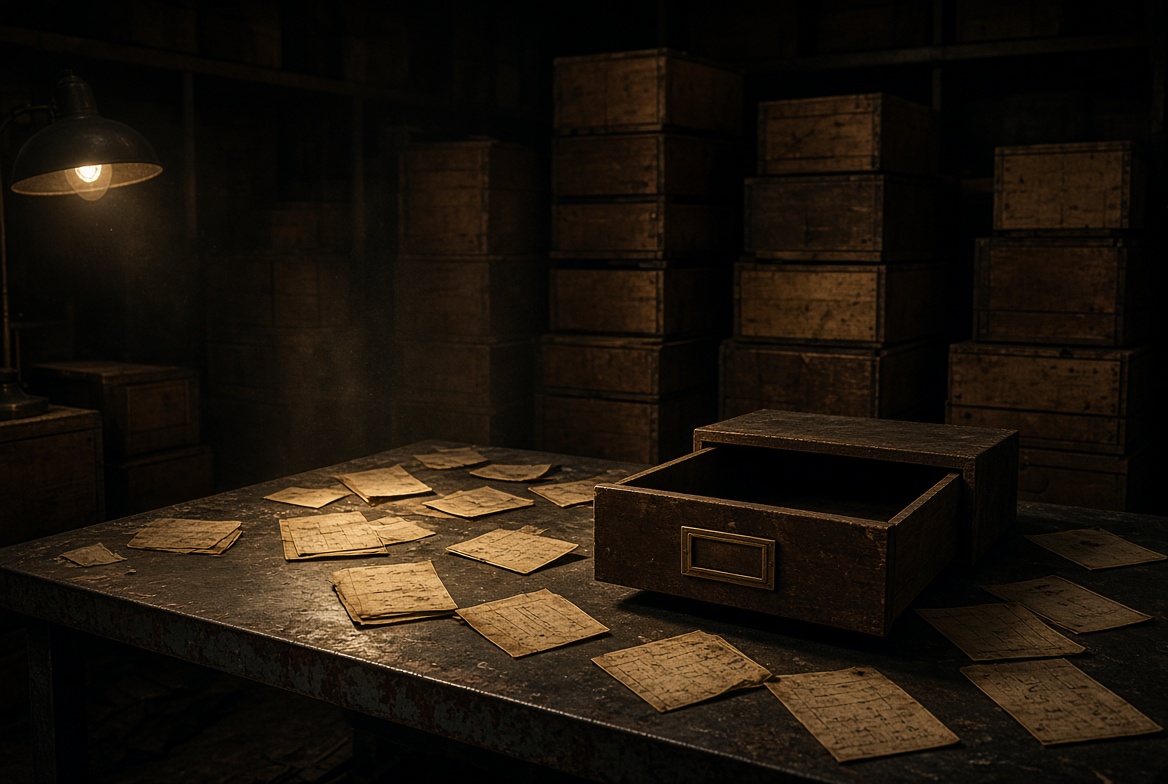
The screening
The picture is filed as The Lost Inventory.
Scenario
2:57 · 16:9
Leta Quarm carries a list that once kept a building from forgetting its rooms. A table lamp at the landing throws light onto a blank card clipped to the board. She has not filled the card, because the decision today is about the mismatch, not a new label. She stands under the lamp long enough for the bulb to warm the blank card's upper edge. The card stays blank. Dust on the board shows where older sheets were pinned and taken down. She walks the corridor with the list held where she can read it. Manila edges stick out of her folder, three of them, none of them the door she is looking for. The building is ordinary. Nothing groans. Nothing plays at clerks. A window at the far end gives plain daylight and no instruction.
At the first turning the doors agree with the paper. She touches nothing. At the second turning a number plate sits level, and the list has that number. She counts the doors she has passed and makes a small mark with her nail beside the count, not a correction. The nail mark is only a dent in the paper. At the third turning the list asks for a door: number 3-14, linen store. What the wall gives her is plaster. No jamb, no seam, no handle. She waits. The plaster does not develop a crack or a shadow in the shape of a door. She sets her palm flat on the place a handle would occupy. The plaster is cool and uninterrupted. The number lives on the paper and opens onto nothing that can be walked. She checks the count again. The paper and the floor do not agree, and she does not correct either of them into politeness.
She sets the folder on her knee and writes, on the list itself, only this: 3-14, wall. The ink is darker than the older entries. She does not renumber the corridor to save the list, and she does not redraw the list to pretend the door is there. While the ink dries she looks once more at the plaster. A faint scuff appears where her sleeve brushed, not an opening, only a duller patch the size of a cuff. That patch is the second change, and it follows the first: the wall stays a wall, and now it shows that she stood there. She does not wipe the scuff. The mismatch is what she keeps.
She walks back. The doors she already counted remain the doors she counted. None of them becomes 3-14 to rescue the paper. At the landing she clips the sheet under the lamp and leaves the blank card blank. The lamp warms both. The new line, 3-14, wall, stays readable. The card above it takes no writing. The nail mark beside the old count is still there, a dent and not a fix. Manila edges still stick from the folder. The plaster at the third turning, out of the lamp's reach, keeps its cuff-sized dullness and its lack of a handle.
Her list and the wall disagree in plain ink, and both stay as they are.
Shooting script
Scene 1. Stair and corridor. Day. 2:57. 16:9.
One place. One hour. It stays one scene.
Leta Quarm, forty-two, carries one building list and a folder with three manila edges. The list gains a darker line, 3-14, wall, and her sleeve leaves a cuff-sized dull patch on plaster where a linen-store door is missing. The blank card under the landing lamp stays blank.
No dialogue.
Breakdown
Day on the stair. Build the lamp, the list, and the blank wall.
Cast. Leta Quarm, forty-two. One adult on the stair and in the corridor.
Landing lamp. A practical table lamp whose bulb can warm paper. It sits at the landing and lights the board.
List and folder. One readable list that takes a nail dent and a darker line. A folder with three manila edges sticking out.
Blank card and board. A blank card clipped above the list. Dust on the board shows older pin places where sheets came down.
Corridor doors. Ordinary doors. Level number plates at the first and second turnings agree with the paper. The third turning is solid plaster.
Far window. Plain daylight at the corridor end. Clear glass, no sign painted on it.
Shot list
Camera. One scene. 16:9.
Nobody looks into the lens. The sizes below are the decoupage, not the literary script.
1 · 0:00–0:12 · Wide. The landing holds a table lamp, a board, and a blank card.
2 · 0:12–0:24 · Close. The bulb warms the upper edge of that blank card.
3 · 0:24–0:36 · Medium. Pin holes in the dust mark sheets that used to hang on the board.
4 · 0:36–0:48 · Wide. Leta walks the corridor with the open list in both hands.
5 · 0:48–1:00 · Close. Three manila edges stick out of the folder.
6 · 1:00–1:12 · Wide. Daylight enters from a clear window down at the corridor's end.
7 · 1:12–1:23 · Medium. The first corner's doors match her paper, and she touches none of them.
8 · 1:23–1:34 · Macro. At the second turning her nail presses a small dent beside the count.
9 · 1:34–1:45 · Wide. At the third turning the wall is plaster where the linen store should stand.
10 · 1:45–1:57 · Close. Her palm lies flat on cool plaster with no seam under it.
11 · 1:57–2:09 · Macro. Darker ink goes onto the list itself as the short line 3-14, wall.
12 · 2:09–2:21 · Macro. Where the jacket cuff met the wall, the plaster goes dull in a small oval.
13 · 2:21–2:33 · Wide. She walks back, and the doors already counted stay those same doors.
14 · 2:33–2:45 · Medium. She clips the written sheet under the lamp, and the blank card stays blank above it.
15 · 2:45–2:57 · Close. The new line stays readable while the cuff patch stays out of the lamp.
Lookbook
Lamp on the blank card.
A table lamp on the landing is the warm source. It heats the upper edge of the blank card, then the written sheet clipped under the same bulb. Daylight from the end window is plain and stops well short of that plaster.
Palette
Blank card. #F4E4C4. The clipped card under the bulb.
Dark ink. #1B2A4A. The new line on the list.
Manila. #D2A56A. The three folder edges.
Plaster. #E6D8C6. The third-turning wall.
Cuff patch. #C9B396. The dull mark left by the sleeve.
Landing wood. #6E4C34. The stair under the lamp.
Far daylight. #B9C6D0. The window at the corridor end.
Board dust. #8E8678. Old pin places on the board.
Lens
Wide holds the landing and the full run of the corridor. Close holds Leta, the list, and the palm on plaster. Macro holds the nail dent, the darker ink, and the cuff-sized dull patch.
Costume
A working sleeve and a readable list.
Leta Quarm is forty-two. The page gives a sleeve and no further garment. Put her in a plain taupe jacket with a cuff that can brush plaster, dark trousers, and quiet shoes.
The cloth keeps that taupe for the hour. The mark the sleeve makes is on the wall, a dull patch the size of the cuff, and the jacket cloth stays the same color.
Hair is pinned off the face so the list stays readable in her hands.
Design
A landing, a corridor, one missing door.
Build one ordinary landing and one corridor that turns three times. The landing needs a board, a blank card, and a table lamp that can warm paper.
Doors at the first two turnings carry level number plates that match the list. The third turning is solid plaster in the place of a linen store. That plaster takes a palm and a sleeve brush and stays a wall.
The list is one sheet that takes a nail dent and a darker line. The folder shows three manila edges. The far window is clear daylight.
Makeup and hair
The hour sits on the writing hand.
Leta is forty-two. Day skin, a little warmth from the lamp on the forehead, hair pinned back.
One nail dents the paper. The writing fingers take darker ink at the tip only as a working stain if the pen touches them. The other palm meets cool plaster and comes away clean.
No paint on the sleeve. The dull patch is plaster, not skin.
Sound
No score. Footsteps, a pen, and a clip.
Footsteps. Ordinary shoes down the corridor and back again. The pace stays even.
Nail. A small dry press when the nail dents the paper at the second turning.
Palm. Skin laid flat on plaster. Soft contact, then quiet.
Pen. A short scratch as the darker line goes onto the list, then silence while the ink dries.
Sleeve. Cloth brushes the wall once. After that the patch is only visual.
Clip. The sheet seats under the lamp at the landing. A small metal bite, then still.
Corridor. The building stays quiet around her. No groan under the steps. The far window adds no sound.