The Mirror That Answers
Key art
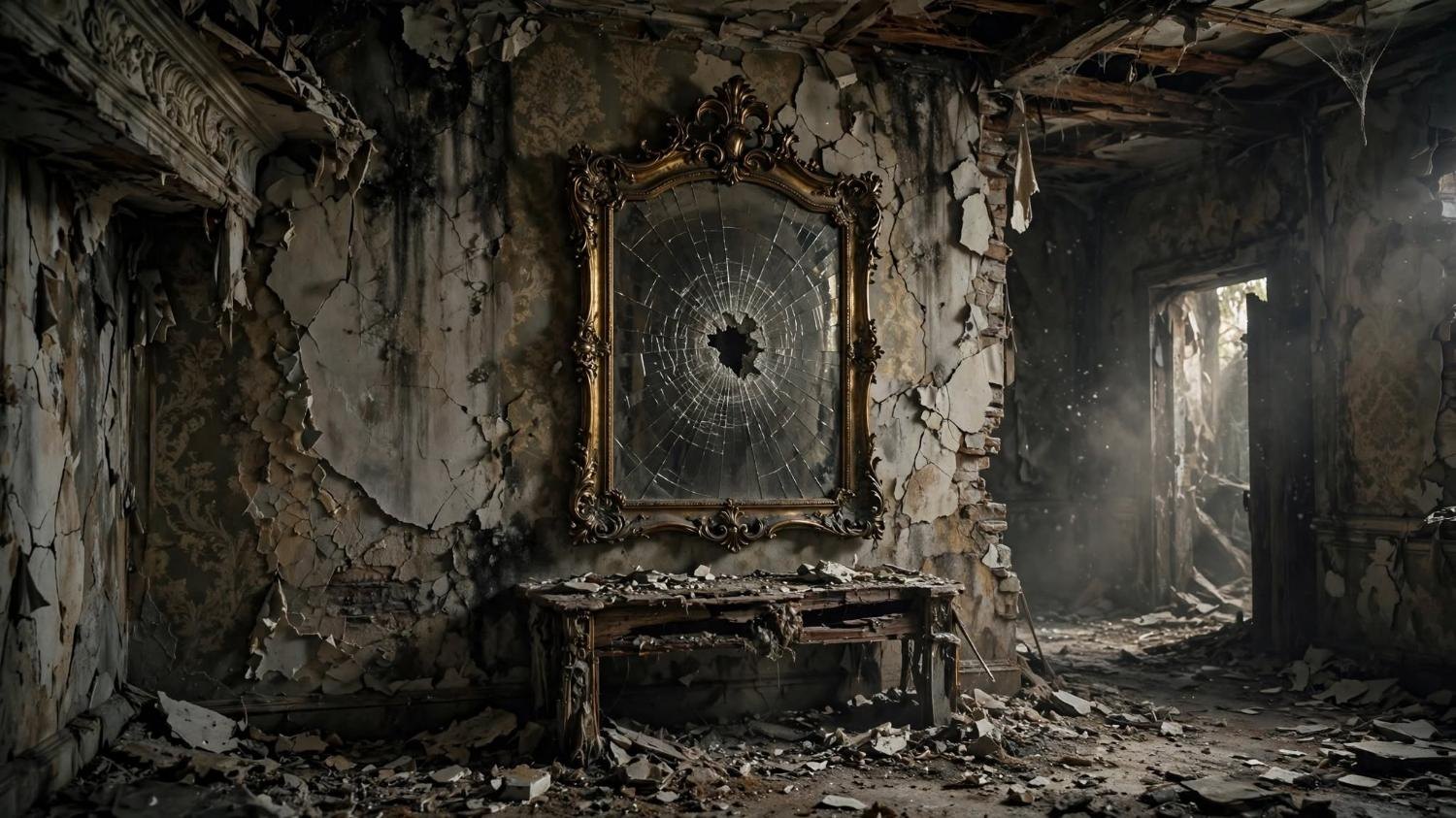
The screening
The picture is filed as The Mirror That Answers.
Scenario
2:57 · 16:9
Plaster has fallen in sheets. An ornate mirror stays on the far wall, glass cracked like a spiderweb, a round hole at the centre. The hole is darker than the cracks that feed it. A woman stands before it in a coat grey with dust. The room in the glass is the same room, and her face sits further back than the wall allows. Fallen plaster on the real floor has a twin in the glass, and the twin lies a little farther from her shoes than the real plaster does.
She raises a hand. The reflection's hand rises a half-second late. She holds the hand up. The glass holds its copy late, and the lateness does not shrink while she waits. She lowers hers. The glass follows, late again. She lifts one finger. The delay holds. She lifts a second finger. The same half-second remains, no better and no worse. The face further on is not only copying her. Its mouth is already open. Dust ticks off the ceiling onto her shoulder and, after the same half-second, onto the shoulder in the glass.
She says one short word. The reflection answers with a word she has not reached yet, and then her own mouth catches up. The two sounds overlap and finish. She does not say a second word. She puts her fingertips to the hole. The glass is cold at the crack and empty at the centre. From the far side of the crack the reflection's hand is already through, in her air, arriving before she finishes the reach. The fingers in her air are dusty. They do not touch her. They occupy the space her hand was going to use.
She stops her reach. The hand from the glass does not withdraw. Dust from the ruined ceiling settles on her sleeve and, a half-second later, on the sleeve in the glass. Then the dust on the glass sleeve lifts again, a small reverse that follows the late settling, while the dust on her own sleeve stays. The hole at the centre stays open, blacker than the crack around it. A flake of plaster at the mirror's upper corner lets go, strikes the raised fingers in her air, and falls through them as if they were only the lateness of a hand.
She drops her arm. In the glass the hand is still raised. The hand that came through the hole remains in her air, empty, and does not complete a greeting. A thin sift of plaster falls through the hole and does not stop. It gathers on the floor beneath the mirror in a pale cone, and the cone in the glass is not there. The delay stays in every small motion left to the room. Her coat does not move. The raised hand in the glass does not tire. The cone on the floor grows by a grain and then by another grain, and the growth does not teach the glass to match it.
The sift continues, and the hole gives no sign of closing around it.
Shooting script
Scene 1. Ruined room. Night. 2:57. 16:9.
One place. One hour. It stays one scene.
A woman of forty-four, coat filmed grey by dust, faces an ornate mirror cracked around a darker round hole. The copy stays late. A dusty hand comes through the hole into her air, and plaster builds a pale heap on the floor that the glass never matches.
She speaks one brief word, and the glass replies from a moment ahead of her mouth. Both lines are spoken and never subtitled.
Breakdown
Night in the ruined room. Build the cracked mirror and the hole.
Cast. One woman, forty-four. The late figure and the hand in her air belong to the mirror, not to a second actor crossing the room.
Mirror. An ornate mirror on the far wall. The glass is a web of cracks. The centre is a round opening, blacker than the web. Cold along the broken edge, vacant in the middle.
Plaster. Sheets of fallen plaster on the floor, with a twin in the glass that can rest slightly wider of her shoes. A flake that drops from the top corner. A pale heap under the mirror that the glass leaves out.
Coat. A coat grey with dust. Dust must land on the shoulder and the sleeve, and stay on her sleeve after the glass sleeve sheds its dust.
The late hand. A dusty hand that can occupy the air in front of the hole, arrive early, and let a plaster flake pass through the fingers.
Shot list
Camera. One scene. 16:9.
Nobody looks into the lens. The sizes below are the decoupage, not the literary script.
1 · 0:00–0:12 · Wide. Plaster lies in sheets, and an ornate mirror remains fixed to the far wall, web-cracked around a black hole.
2 · 0:12–0:24 · Medium. The woman faces it in a coat filmed grey by dust.
3 · 0:24–0:36 · Close. The glass shows this same room, her face set too far back, the plaster twin resting slightly wider of the shoes.
4 · 0:36–0:48 · Medium. She lifts a hand, and the copy rises late, the gap holding while she waits.
5 · 0:48–1:00 · Close. She lowers the hand, the glass follows late, and a second finger keeps that same delay.
6 · 1:00–1:12 · Close. The farther face already holds an open mouth.
7 · 1:12–1:24 · Macro. Grit leaves the ceiling for her shoulder, and the glass shoulder receives it only after the delay.
8 · 1:24–1:36 · Medium. She speaks one brief word, the glass replies from ahead of her mouth, the sounds cross, and she stops.
9 · 1:36–1:48 · Macro. Fingertips find the hole, cold on the cracked side and vacant in the middle.
10 · 1:48–2:00 · Medium. A dusty hand is already out in her air, in the place her reach was going to use, and it never meets her skin.
11 · 2:00–2:12 · Close. She halts the reach, that hand stays out, her sleeve keeps its dust, and the copy's sleeve shakes its dust back off.
12 · 2:12–2:23 · Macro. A plaster flake drops from the top corner, strikes those fingers, and passes straight through.
13 · 2:23–2:34 · Medium. Her arm drops, the glass hand stays raised, and the hand in her air keeps no greeting.
14 · 2:34–2:45 · Close. Plaster sifts through the opening and builds a pale heap the mirror refuses to copy.
15 · 2:45–2:57 · Wide. The opening stays black, the coat hangs still, the glass hand keeps its raise, and the heap gains another grain.
Lookbook
Weak night on cracked glass.
Night is the only source, thin enough to catch fallen plaster and the grey coat. It leaves the round opening blacker than the web around it. Dust in that light makes the half-second gap readable between her shoulder and the glass.
Palette
Dusty coat. #9A9186. The grey cloth on the woman.
Fallen plaster. #E8DDCC. Sheets on the real floor.
Crack web. #C9D3D6. The broken glass around the hole.
Centre hole. #0D0B09. The round opening, darker than the cracks.
Pale heap. #EFE8D8. Plaster gathering under the mirror.
Skin. #C6A88A. Her hand and the dusty fingers in the air.
Night wall. #4C423C. The far wall around the frame.
Sleeve dust. #B9AA9A. The scatter that stays on her sleeve.
Lens
Wide holds the ruined room and the mirror on the far wall. Close holds the woman and the late copy of her hand. Macro holds the hole, the fingertips, and the plaster grain.
Costume
A coat already grey with dust.
The woman is forty-four. She wears one coat filmed grey by dust, over dark plain clothes. Hair is pinned back. Shoes are the ones the plaster twin measures itself against.
Fresh dust lands on the shoulder and stays on the sleeve. That is the change in the cloth. The coat hangs still once her arm drops.
The hand in her air wears no separate costume. It is dusty skin arriving early.
Design
A ruined room and one broken mirror.
One room. Plaster has come down in sheets. An ornate mirror is fixed on the far wall, glass in a web of cracks, a round opening in the middle that stays open.
The glass must show the same room late: her face too far back, the plaster twin resting slightly wider of the shoes, a hand still raised after hers has dropped, and no pale heap.
A practical trickle of plaster drops through the opening and builds on the floor. One flake must pass through the early fingers. Dust must be able to land, stay on her sleeve, and lift off the glass sleeve.
Makeup and hair
Dust on the shoulder, cold on the fingers.
She is forty-four. Adult skin in weak night, hair pinned, a few plaster grains allowed in the hair. No injury.
Fingertips take cold where the crack is, and empty air at the hole. Dust ticks onto the shoulder and stays.
The early fingers are the same skin, dustier, and a flake passes through them. Her face and the late face match, except the glass mouth is already open.
Sound
No score. Dust tick, two overlapping words, falling plaster.
Dust tick. Fine grit leaving the ceiling for her shoulder, then, after the delay, for the glass shoulder.
The word. One brief word in her voice. The glass replies with its own word from ahead. The two voices cross and then both end. She gives no second word.
Fingertips. Skin on cold cracked glass, then nothing at the empty centre.
Flake. A small strike on the early fingers, then a fall with no body to stop it.
Sift. A thin pour through the hole that keeps going and builds the heap.
Sleeve dust. The copy's sleeve gives a tiny lift of grit. Her own sleeve stays quiet.
Held room. After the word, the room keeps only the sift. The coat makes no further move.