The Single Door
Key art
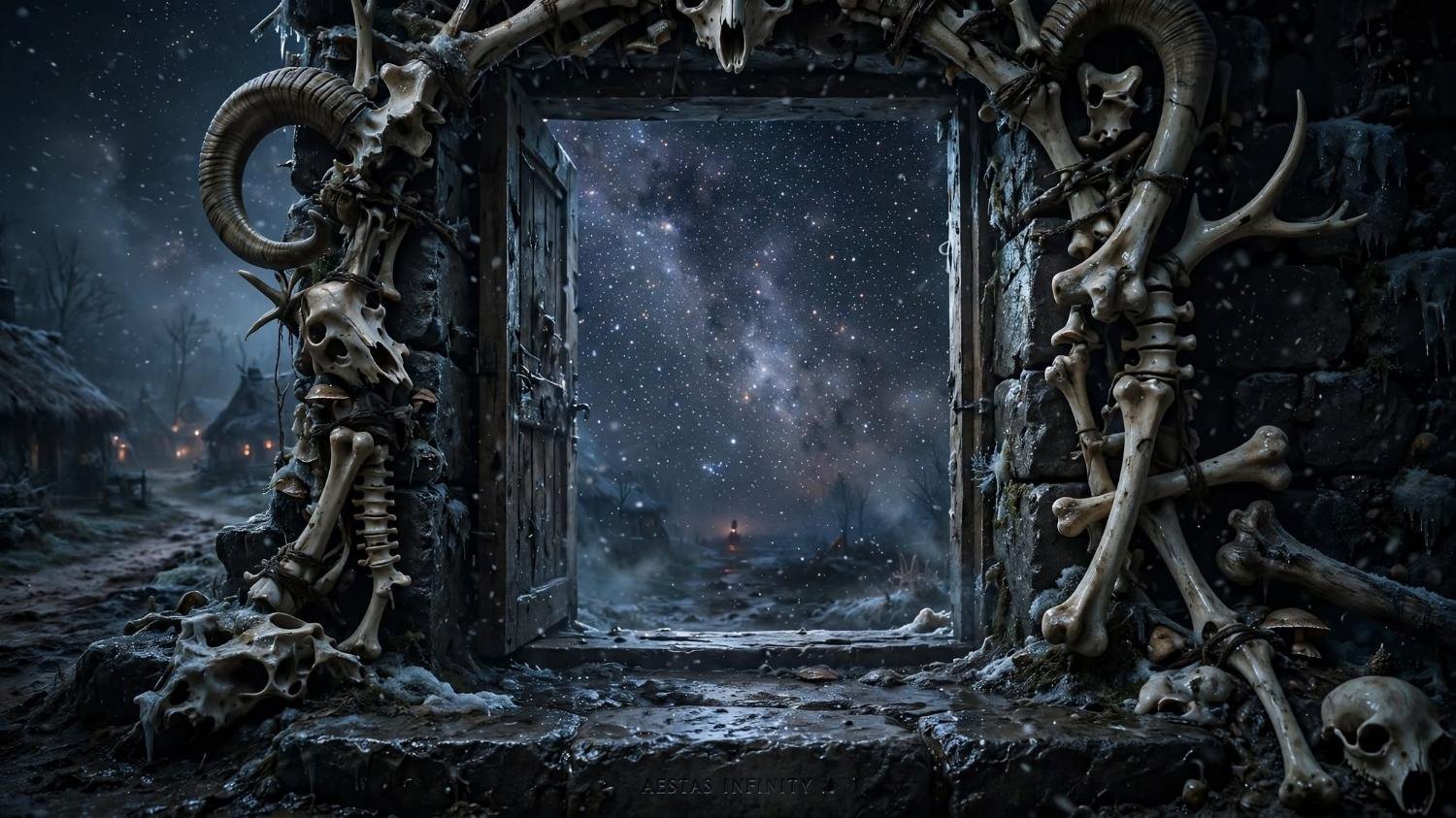
The screening
The picture is filed as The Single Door.
Scenario
2:57 · 16:9
A door of bone and horn stands on the village path, open, and past the threshold there are only stars. The bone is fitted, not a ruin, and the horn makes a dark curve along the lintel. Rain falls on the village side of the sill and stops there. It does not cross. Drops strike the near stone and do not strike the star side. A horned skull is fixed in the stone beside the jamb. The bone around the doorway is wet, and the wet does not dry. Lights in the village windows burn their ordinary yellow farther down the path. Nothing in those windows changes because the door is there. A shutter stays as it was. A yellow square stays a yellow square.
A figure stands with their back to the houses, cloak torn at the hem. One foot is already through the doorway. On the star side the torn cloth is full of small lights. On the rain side the same cloth is only wet wool. The division is exact at the plane of the door. Rain beads on the wool and does not bead on the lit half. The figure draws the foot back onto the path. Stars shake off the boot and go dark on the wet stone. The dark they leave is a print the rain does not wet, a small dry shape in the wet, and that dryness follows the withdrawal without inviting the rain across the sill.
They set the foot through again. The boot takes stars at the toe. The torn hem on the star side gains a few more points of light and does not mend. The path at their heel does not follow them over. Rain keeps strictly to its own half. They stay in the doorway, divided at the ankle. The bone glistens and does not dry. The skull faces the road. The yellow windows do not brighten and do not go out. The dry print of the first withdrawal remains on the village stone, unwet, while new rain avoids it.
The figure does not bring the second foot across and does not plant both feet back on the path. Division at the ankle is the place they keep. Stars on the far half of the torn hem do not leak onto the wet wool. Rain on the near half does not spark. The horned skull stays fixed beside the jamb, facing the road, and the road's rain ends at the sill in the same strict line. Yellow windows farther down the path burn as they burned before the door was stood there. The dry print of shaken stars remains a small unwet shape on the village stone. The bone of the doorway glistens. The horn along the lintel stays dark. No shutter changes because of any of it.
The bone glistens and does not dry. The village windows keep their old light, and the skull faces the road that will not cross.
Shooting script
Scene 1. Village path. Night. 2:57. 16:9.
One place. One hour. It stays one scene.
A cloaked adult of forty-one stands in an open door of fitted bone and horn on the village path, stars filling the opening. One foot crosses and comes back, shaking stars off the boot into a dry print the rain misses. The foot crosses again. The body stays split at the ankle, wet wool on the rain side of the torn hem and small lights on the star side.
No dialogue.
Breakdown
Night on the village path. Build the bone door, the torn cloak, and the rain line.
Cast. One adult, forty-one, facing away from the houses, hem of the cloak already ripped. No one else.
Door. A fitted door of bone and horn, open on the path. Horn makes a dark curve on the lintel. Bone stays wet and glistening. Past the opening, only stars. The door frame is the plane that splits cloth, rain, and the foot.
Rain and skull. Rain on the village half only, ending at the sill. A horned skull set into the stone next to the frame, looking along the road. A small dry print on the wet stone where stars left the boot, and new rain avoids that print.
Cloak. Torn at the hem. Rain half is wet wool with beads. Star half fills with small lights, gains a few more when the foot crosses again, and stays torn. The split is exact at the door's plane.
Village. Ordinary yellow squares farther along the path. A shutter that stays as it was. Those squares keep their old light with the door standing there.
Shot list
Camera. One scene. 16:9.
Nobody looks into the lens. The sizes below are the decoupage, not the literary script.
1 · 0:00–0:13 · Wide. Fitted bone and dark horn make an open door on the path, and the opening holds only stars.
2 · 0:13–0:26 · Medium. Rain hits the village stone and ends in a strict line at the sill.
3 · 0:26–0:39 · Close. A horned skull is fixed beside the jamb, and the bone stays wet.
4 · 0:39–0:52 · Wide. Farther down the path the windows burn an ordinary yellow and keep that yellow.
5 · 0:52–1:05 · Medium. The figure stands facing away from the houses, hem ripped, one foot already past the plane.
6 · 1:05–1:18 · Close. Starward, the ripped hem holds tiny lights, and rainward the same wool is only wet.
7 · 1:18–1:31 · Macro. Drops gather on the wool and spare the lit half.
8 · 1:31–1:43 · Medium. The foot comes back, star-points leave the boot and die on the stone, and a dry print remains that later rain misses.
9 · 1:43–1:55 · Close. The foot crosses again, the toe takes stars, and the starward hem gains a few more points while staying torn.
10 · 1:55–2:07 · Wide. The body stays split at the ankle, rain keeps its own half, and the skull looks along the road.
11 · 2:07–2:19 · Medium. The yellow windows neither brighten nor go dark, and the dry print stays unwet.
12 · 2:19–2:31 · Close. The second foot stays on the path, and the star-points stay off the wet wool.
13 · 2:31–2:44 · Macro. The bone keeps its shine, and the lintel's horn remains a dark curve.
14 · 2:44–2:57 · Wide. The door remains the split, the village light unchanged, the skull still toward the road.
Lookbook
Yellow windows and star dark.
Night on the path is lit by ordinary yellow squares farther along, and by the stars crowded in the open door. Rain on the village stone catches that yellow. The bone glistens. The horn stays dark. The torn hem splits the light exactly where the door cuts the air, wet wool on one side and small star-points on the other.
Palette
Bone. #E4D6C0. The fitted doorway, wet and shining.
Horn. #2A241C. The dark curve on the lintel.
Rain stone. #7A8490. The wet village side of the sill.
Star field. #0C1220. The opening past the door.
Window yellow. #E6C15A. The ordinary squares down the path.
Wet wool. #4A5560. The rain half of the torn hem.
Star cloth. #C9D4E8. The lit half of the same hem.
Dry print. #3A342C. The unwet shape left by shaken stars.
Lens
Wide holds the path, the door, and the yellow squares in one place. Close holds the figure where the door cuts the air. Macro holds the hem, the beads, the dry print, and the horn. Stars stay inside the opening and are not a second world.
Costume
A torn cloak split by the door.
The figure is forty-one. A cloak torn at the hem, wool, dark on the rain side. Shoes that can take stars on the toe and shake them off.
The change is in the hem. Rainward it is only wet wool, beaded. Starward the same cloth fills with small lights and gains a few more points on the second crossing, and the tear stays a tear.
The split stays exact at the door. No other garment changes. The body remains divided at the ankle, one shoe still on the path.
Design
A bone door on a rainy path.
One village path at night. An open door of fitted bone and horn stands on it, stars only in the opening. Rain strikes only the village half and ends at the sill. A horned skull is set into the stone next to the frame, looking along the road.
Yellow windows burn farther down and never change. A shutter stays. The bone must stay wet and shining. The horn stays a dark curve.
The cloak's hem must read as two cloths at the door's plane: wet beaded wool and a field of small lights. A boot must shake stars onto the stone as a dry print that new rain avoids. One foot crosses, returns, and crosses again. The other foot stays on the path.
Makeup and hair
Wet wool and starlight meet at the ankle.
The figure is forty-one. Night on the face, a little yellow from the far windows, hair whatever the hood or the rain leaves visible. No injury. The torn hem is cloth, not a wound.
Drops gather on the wool and on the near skin if the cloak is open, and they spare the starward half. The boot that crosses takes a scatter of lights at the toe and then sheds them.
The ankle is the line. One foot is path-wet, one is briefly starred. Hands can stay inside the cloak. The face looks toward the opening and gives no speech.
Sound
No score. Rain on one side of the sill, stars shaken off a boot.
Rain. Drops on the village stone, ending sharply at the sill. The star side takes no strike.
Cloth. Wet wool takes beads. The lit half stays quiet of rain.
Boot back. The foot returns. Stars shake off and go dark on the stone. The dry print makes no splash under later drops.
Boot through. The foot crosses again. A few more points arrive in the hem. No mending sound.
Skull and windows. The skull and the yellow windows add nothing. No shutter moves.
Bone. Wet bone is quiet. It keeps its shine without a drying tick.
Held split. The second foot stays on the path. Rain and stars never trade sides.